The Aiba
Trust & Safety Principles
21 ways to build safer communities
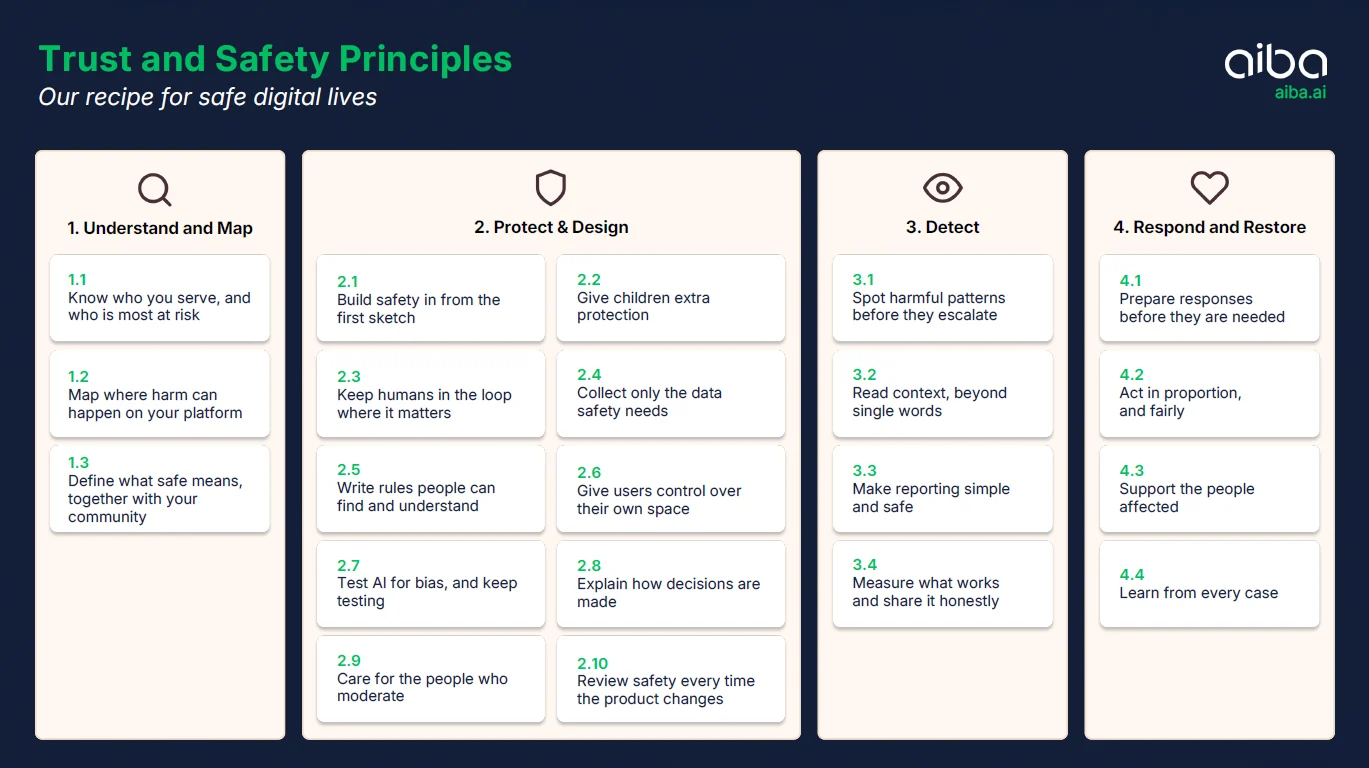
Norway’s National Security Authority (NSM) gives security teams a shared place to start: 21 principles in four categories, from mapping what matters to recovering when something goes wrong.
NSM has refined its principles since 2017, and is clear that every organisation must adapt them to its own situation. We kept wishing for the same thing in trust and safety: a short list that shows what good looks like, before anyone talks about tools.
So we wrote one. The Aiba Trust and Safety Principles borrow NSM’s structure, four categories and 21 principles, rebuilt around the people who use your platform
Understand and Map
Understanding comes first
The first three principles start with people: who your users are, where harm can happen, and what safe means to them.
A teen chat carries different risks than an adult marketplace, and voice behaves differently from comments. Map this first: the right measures in the wrong place protect very little.
Principle 1.3 asks you to define what safe means, together with your community. It takes longer, but rules written with the people they protect are easier to explain and defend.
Protect and Design
Protection is designed in
The biggest category, with ten principles. Its core idea: safety belongs on the drawing board, next to the feature it protects. Three principles deserve a closer look.
Principle 2.10 closes the category: review safety every time the product changes. A new DM feature brings risks the last review never saw.
Detect
Detection reads context
Harm rarely shows up in one message. Grooming and harassment build across many small interactions that look harmless alone. That’s why this category looks at patterns and context across whole conversations.
Reporting should be easy and safe. And principle 3.4 asks teams to share what works, including what the system misses. It’s uncomfortable, and it builds trust.
Respond and Restore
Response starts with a person
Behind every case is a person, often several. This category covers what happens next: preparing in advance, acting fairly and in proportion, supporting those affected, and learning from each case.
Proportion cuts both ways. Too little leaves people exposed. Too much punishes honest mistakes and wears down trust in the rules.
NSM’s illustration marks this category with a flame. We chose a heart.
A safe community is designed,
watched over and cared for.
Use them as a starting point
Adapt them to your platform. A small indie studio and a large social network will pick different priorities, and both can be right.
- 1
Go through the overview with your team and mark what you cover.
- 2Pick the two or three biggest gaps.
- 3
Revisit the list when your product changes. Yes, 2.10 applies here too.
Make them your own
Print them, pin them up, argue about them. The best version is the one your team has tested against its own community.