There Is a Human in the Loop.
They Just Cannot Keep Up
The trust and safety industry has leaned on “human in the loop” for a decade. It is time to be more honest about what that phrase delivers.
Human in the loop has become one of those phrases that signals responsibility without requiring anyone to define what it means. Add a human somewhere in the process, the thinking goes, and you have meaningful oversight. The AI is not acting alone. Someone is watching.
The problem is that watching is not the same as overseeing.
800 cases.
30 seconds each.
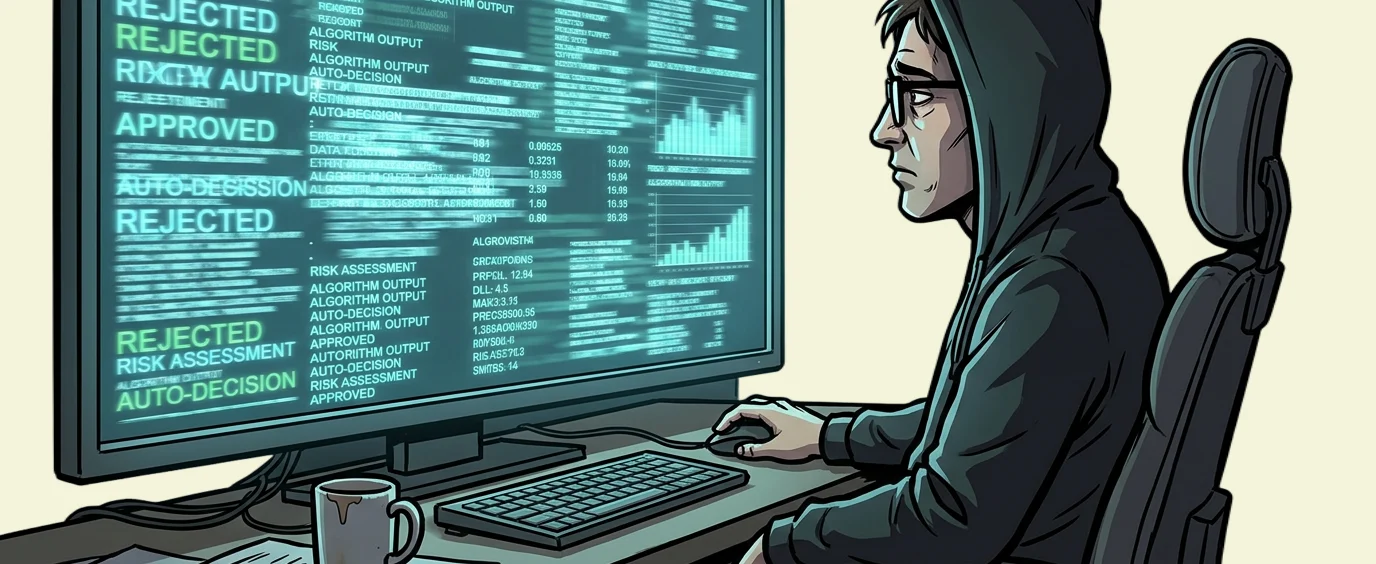
Picture a content reviewer working through a moderation queue. They have 800 cases in front of them. The system has already scored each one. The interface presents a recommendation. The reviewer has roughly 30 seconds per case.
There is technically a human in the loop. But the reviewer is not evaluating each case from scratch. They are mostly confirming what the model already decided, with occasional exceptions for cases that feel obviously wrong. That is not oversight in any meaningful sense.
This matters because the presence of a human in a workflow is often used to justify a level of trust in the system that the workflow does not support. If a bad decision gets through, the human was there. If a pattern of bad decisions emerges, the human was there for all of them. The accountability is real but the oversight was not.
Coverage is not
the same as judgment
The Digital Trust and Safety Partnership makes a useful distinction in their AI and Automation report. For clearly defined, high-volume content categories, AI and automation can make reliable decisions. For complex or ambiguous cases, the role of automation should be to route and prioritize content for human review, not to make final determinations.
That distinction says something about what human reviewers should be doing. Their job is not to process an undifferentiated queue. It is to exercise judgment on the cases where the model cannot. That is a different cognitive task, and it requires different conditions to do well.
A reviewer who is fatigued from volume, working in an interface designed around throughput, and given no indication of why a case was escalated, is poorly positioned to catch what the model missed. The human is present. The conditions for good judgment are not.
How Aiba designed
around this
This is one of the design problems that shaped how we built Amanda.
Our three-tier filtering architecture routes by confidence, not by volume. Basic rules and blocklist filtering handle the clearly defined cases. Our small language models handle the more contextual ones. What reaches a human reviewer is the residue: cases where confidence is low, context is ambiguous, or where the stakes of a wrong decision are high enough to warrant a second look.
Reviewers working within Amanda spend their time on cases that genuinely need human judgment. We also surface the reasoning behind each escalation. A reviewer should be able to see why a case landed in front of them, not just what it contains. Without that context, the human element becomes a formality rather than a safeguard.
Three things that
matter more than
headcount
There is no universal answer, but a few principles hold across most contexts.
Volume and judgment do not mix well. If a reviewer is handling enough cases that each one gets seconds of attention, the human element is providing coverage, not oversight. That may be acceptable for low-stakes decisions. For enforcement actions with real consequences for real people, it is not.
Interface design shapes outcomes. A system that presents model recommendations prominently and requires active effort to override will produce different results than one that presents cases neutrally and asks the reviewer to reach their own conclusion. Both have a human in the loop. The design of each produces different quality of judgment.
Escalation logic should be explicit. Reviewers should know why a case was sent to them. Without that context, they are deciding in a partial information environment, which is precisely the situation human oversight is supposed to prevent.
Regulators are starting
to ask harder questions
DSA, the UK Online Safety Act, and similar frameworks are becoming more specific about what meaningful human oversight requires in automated enforcement systems. Pointing to the presence of a human reviewer is unlikely to satisfy regulators who ask how that reviewer was equipped, what information they had, and what conditions they were working under.
The platforms that handle regulatory scrutiny well are the ones that can answer those questions concretely.
The question is
The useful question for any T&S team is not whether humans are in the loop. They almost certainly are. The useful question is whether the conditions you have created allow those humans to exercise the judgment you are relying on them for.
If the answer is uncertain, that is worth sitting with. The gap between nominal oversight and real oversight is where most avoidable failures live.
If you are thinking through how your moderation setup handles agentic risk, we are happy to talk through what we are seeing across gaming and community platforms.