How to Moderate a Gaming Discord Server
If your game is taking off and your Discord server is growing fast, moderation is probably not at the top of your list. It should be. This article explains why gaming Discord communities are uniquely vulnerable, what happens when moderation is ignored, and how to moderate a gaming Discord server without building a full trust and safety team.
The games that
won 2025 were
built around Discord

Something shifted in gaming last year. The biggest story was not a $200 million AAA blockbuster. It was two games made by tiny teams, sold for less than $10, that spread because groups of friends could not stop playing them together.
R.E.P.O. and PEAK finished as the second and third most downloaded PC and console games of 2025, according to Sensor Tower data. No massive marketing budget. No years-long development cycle. Just a tight social loop, a Discord server, and word of mouth that moved faster than any paid campaign could.
This a formula rather than a fluke, and it is going to produce more games like these. But the Sensor Tower report that surfaced these numbers does not talk about what happens to the communities that form around them. That is the part worth understanding.
This is not a comment on how those studios run their communities. The point is structural: any server that grows faster than anyone planned for faces the same pressure, regardless of how good the intentions are.
The formula works
until it doesn’t

Games like these spread fast for a specific reason: they are built around high-emotion, high-stakes moments between small groups of friends. Falling off a mountain. Yelling at each other over a botched heist. The kind of shared chaos that makes great stream content and even better memories.
That intensity is the product. It is also what makes these communities volatile.
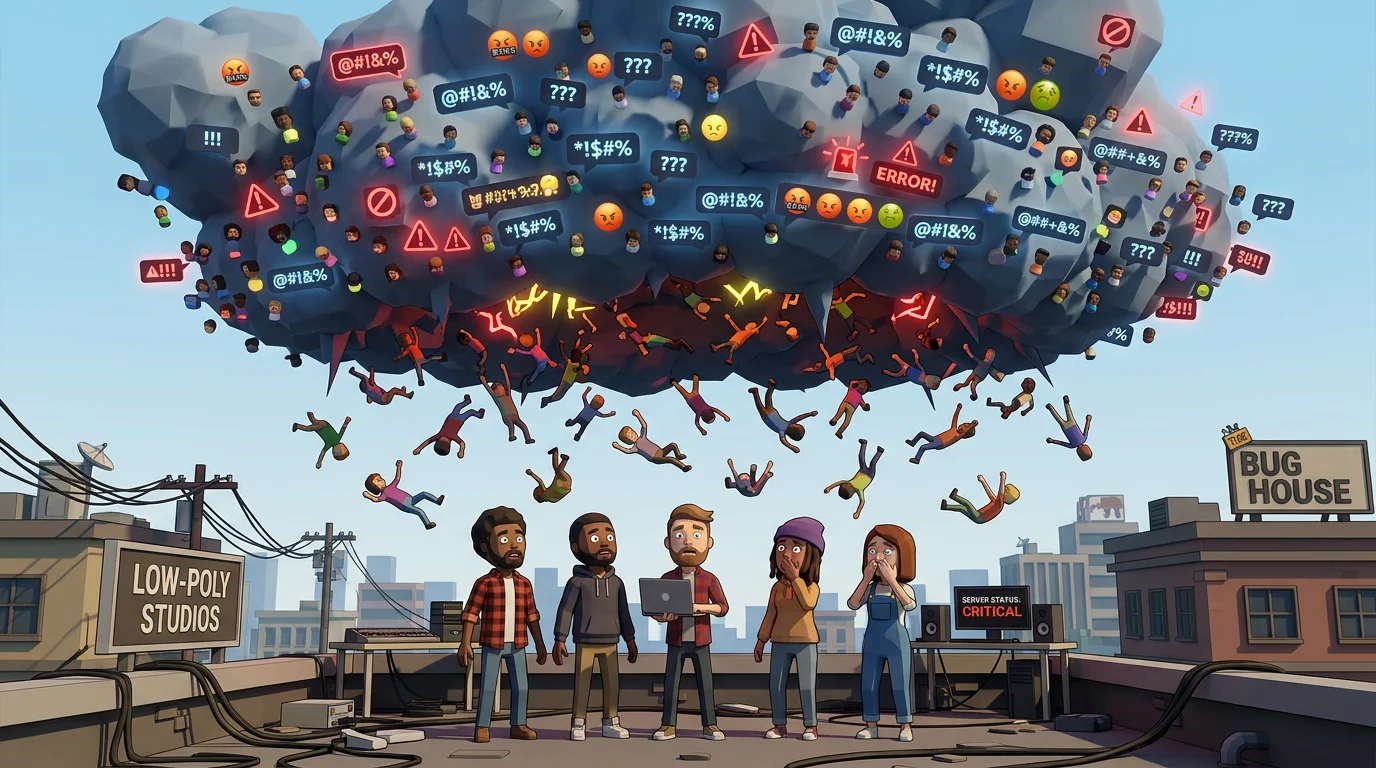
When a game like this explodes, the Discord server grows overnight. Thousands of players arrive, most of them strangers. The original community feel (that sense of playing with your crew) starts to erode. The same social energy that made the game viral can start working in reverse: harassment, raiding, coordinated toxicity from bad actors who know exactly how to exploit an unmoderated space.
The studio, meanwhile, is still a small team. They shipped a hit. Now they are drowning in support requests, bug reports, and the sudden reality that they have a community of tens of thousands they were not set up to manage.
Discord Is the Community.
Treat It That Way.
Discord gives studios a solid foundation. AutoMod, channel permissions, role structures: the basics are there. The gap is not the platform. It is that most small studios stop there and assume it is enough.
For this category of game, Discord is the community: the place where players organize sessions, share clips, report bugs, and build the social fabric that keeps them coming back. The in-game experience is the product. The Discord server is where the product lives between sessions.
That makes it the most important thing to protect, and the most commonly neglected.
Small studios tend to treat moderation as something they will get to eventually. A few volunteer moderators, a basic word filter, and the assumption that the community will mostly self-govern. That works at a few hundred members. It does not work at fifty thousand.
The studios that lose their communities rarely lose them to one catastrophic event. They lose them slowly. A wave of toxic behavior that goes unaddressed. A few high-profile streamers who quietly stop engaging. A sense among the original players that the vibe has changed. By the time it is visible in the numbers, it is already too late.
How to moderate
a gaming Discord server:
A practical framework
Knowing you need moderation and knowing how to set it up are two different things. Two things matter most.
Identify the patterns before they become problems
In most communities, a small number of users drive most of the harmful behavior. AI-powered moderation tools can surface those patterns early: repeat offenders, escalating language, coordinated harassment, so you can act before an incident spreads. The right time to set up your moderation infrastructure is before the server gets large, not after. Reactive moderation, where you respond after something has already damaged the community, is harder, slower, and often too late.
Protect your volunteer moderators
Volunteer mods are often the heart of a gaming community. They are also the first people to burn out when moderation becomes overwhelming. Giving them proper tooling (clear escalation paths, AI-assisted triage, and the ability to focus on cases that actually need human judgment) is one of the most important things you can do to keep your community running long-term. There is a longer piece on moderator burnout and what it costs communities on the Aiba blog worth reading if this is a concern for your team.
Safety is not a
Big-Studio Problem
There is a common assumption in this industry that trust and safety infrastructure is something you build when you are big enough to afford it. That assumption is wrong, and it can cost studios their communities.
One pattern we see repeatedly: a platform’s moderation team starts absorbing a growing wave of user-generated content with no extra support. Reports pile up. Moderators burn out. The community culture quietly deteriorates before anyone in leadership notices. We wrote about how one gaming platform reached exactly this point, and what it took to turn things around, in our MovieStarPlanet case study.
A small game with a large, fast-growing Discord carries real risk, often more than an established platform, because there is less institutional knowledge, fewer trained moderators, and no playbook for when things go sideways.
The good news is that the tooling has caught up. You do not need an enterprise budget or a trust and safety department. You need the right infrastructure from the start: something that handles the volume, flags the patterns, and lets your team focus on the things that actually require human judgment.
FAQ
Yes. Community size is not what determines risk. Growth rate is. A server that doubles in a week is far more vulnerable than a large server that grows slowly. Small studios with fast-growing communities are often the most exposed, precisely because they have the least moderation infrastructure in place.
Waiting. Most studios treat moderation as something to deal with after launch, once problems appear. By then, the community culture is already forming, with or without guardrails. Setting up basic moderation before launch costs almost nothing and prevents a lot of damage.
No, and it should not try to. AI handles volume: catching the obvious violations fast, at scale, before they spread. Human moderators handle judgment: the nuanced cases, the appeals, the things that require context. The combination is what makes moderation both effective and fair. Tools like Amanda’s Discord moderation bot are built around this balance.
Start with Discord’s built-in AutoMod for the basics, then layer an AI moderation tool on top to catch what AutoMod misses: tone, intent, disguised language, escalating patterns. With the right setup, a very small team can manage a large server effectively. You can read more about how AI-driven moderation works in practice here.
At minimum: clear community guidelines, channel structure with appropriate permissions, AutoMod configured for your audience, and an AI moderation layer that can scale with the server. Having an escalation path for serious incidents (harassment, threats, potential safeguarding concerns) is also essential. If minors play your game, plan ahead: the proposed EU KIDS Act names online video games directly.

Protect the community
you worked hard to build
Aiba’s Discord bot brings AI-driven moderation directly into your server. It detects toxic behavior in real time, catches what word filters miss (tone, intent, disguised language) and scales with your community as it grows.
You do not need a large moderation team. You do not need to build your own tooling. You need the right infrastructure from the start, and a small team that can focus on the cases that actually matter.
If you are shipping a social game and Discord is part of your community strategy, we would like to show you what it does.
Download data referenced in this article is sourced from Sensor Tower’s State of Gaming 2025 report, as reported by Deconstructor of Fun. The full report is free to download at sensortower.com.