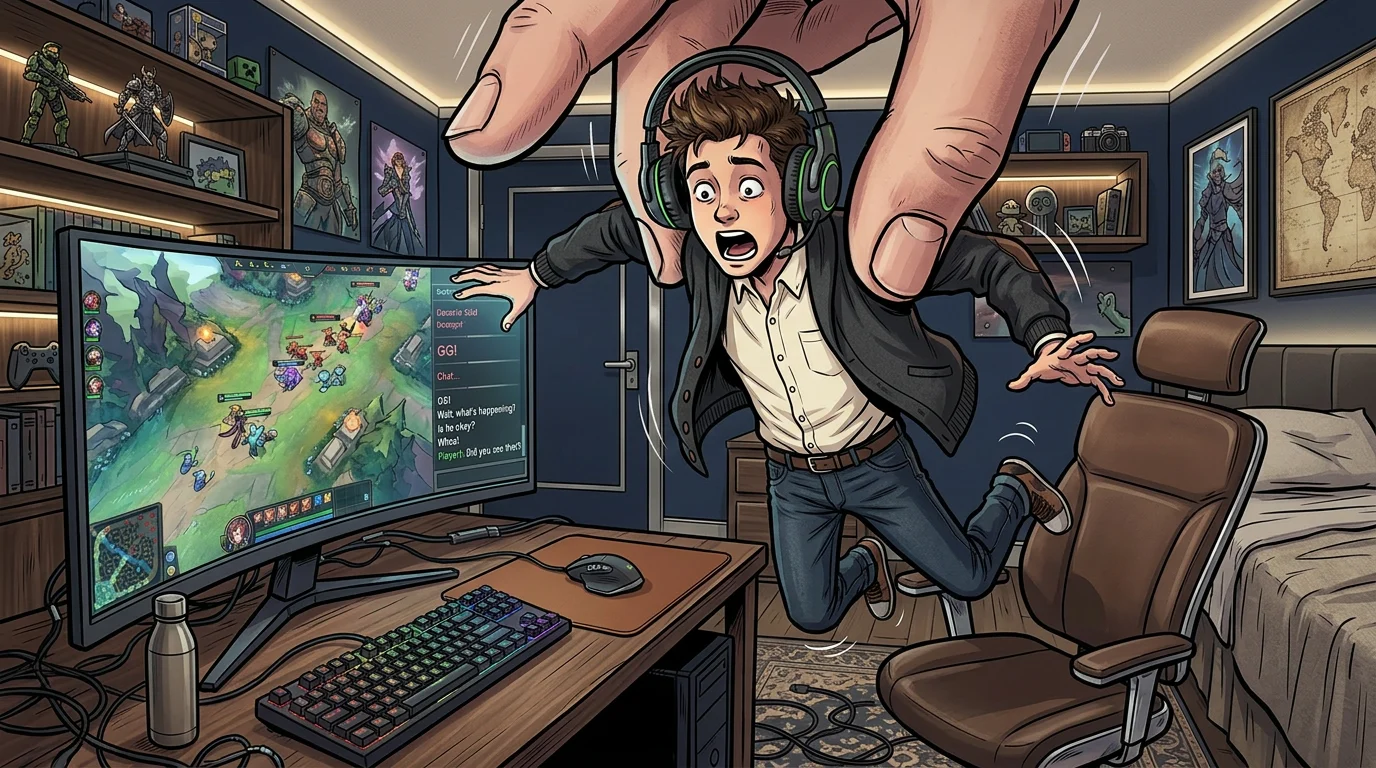
A player types “I’m going to destroy you” into chat. The moderation system flags it, issues a warning, and the player gets a strike against their account. They were trash-talking an opponent before a ranked match. Competitive banter, flagged as a threat.
This is the context problem. And it sits at the heart of why so many moderation systems produce false positives that frustrate players, damage trust, and quietly push people away from games they love.
The real cost of a false positive
A false positive is when a moderation system acts on something that was not actually harmful: a wrongful warning, an account restriction triggered by normal gameplay language, a chat message blocked because it matched a phrase that is toxic in one context and completely ordinary in another.
The immediate impact is obvious: a frustrated player. The downstream effects are more serious.
- Players who are wrongly actioned rarely appeal. They just lose trust.
- Repeat false positives in a community build a reputation. Players talk. “This game bans you for nothing” is a common complaint in gaming forums, and it spreads.
- Support teams inherit the fallout. Appeals, complaints, and the manual work of reversing bad decisions take up time that should go toward real safety issues.
- Under the EU Digital Services Act, platforms must log appeals and track reversal rates. A high false positive rate creates a compliance paper trail that regulators can scrutinize.
Most of these problems share a root cause: the moderation system did not understand what it was looking at.
Gaming language breaks general-purpose AI
Most AI moderation models are trained on broad datasets: social media posts, news comments, web forums. Gaming communities speak a different language.
Gamers use profanity as punctuation. In game voice and text chat is intense, fast, and emotionally charged. The same words that signal aggression on one platform are expressions of camaraderie in a gaming lobby. Context carries the meaning.
A few specifics that trip up keyword based filters and tools that strip messages of context:
- Gaming slang evolves fast. “Griefing”, “camping”, “ganking”, “throwing”: these terms have precise meanings in gaming communities that a general model may not recognise or may misclassify.
- In group language. Friends insulting each other affectionately. Raid groups using dark humour as social glue. These patterns look alarming in isolation and completely normal in context.
- Game-specific phrases. Spells, moves, character names, and community-specific callouts frequently contain words that overlap with harmful content patterns.
- Sarcasm and roleplay. Gaming communities use roleplay and fictional framing constantly. A threat delivered in character reads very differently to a moderator who has the full conversation than to one who sees a single message.
A model that processes each message in isolation, without awareness of the surrounding conversation, the platform, the game, or the community norms, will get a significant portion of these wrong. That is where false positives come from.
The difference between flagging words and understanding behaviour
Keyword filters catch the obvious. They are still useful. But they were never designed to carry the full weight of moderation in a live gaming environment.
The more accurate picture of harmful behaviour in games is behavioural and conversational. A grooming attempt does not usually begin with explicit content. It begins with building trust: compliments, offers of help, requests to move to a different platform. In gaming, this often plays out in multiplayer lobbies or game-linked Discord servers, where the informal atmosphere makes it easy to miss. A harassment campaign may involve individually harmless messages that only become a pattern when viewed across time.
Catching these requires a tool that reads the exchange in sequence, tracks escalation across messages, and understands intent from behaviour rather than from individual words.
The same logic applies to false positives. A single message flagged in isolation may look harmful. The same message, read against the five messages before it, may be obviously fine. Context changes the call.
Aiba approached this problem from the ground up. Rather than adapting a general language model, the research foundation behind Amanda was built on behavioural science: studying how harmful patterns develop across real conversations over time.
Building moderation that gets it right
Reducing false positives takes a few things working together.
Training data that reflects the actual community
A model trained on generic text will perform generically. A model trained on gaming language, across the genres and communities a platform serves, will produce far fewer false positives in those environments. The performance gap shows up immediately in the first scan.
Reading the full exchange, not just the message
Individual message scoring misses too much. A good tool reads the thread, understands the relationship between participants, and factors in what came before. This is harder to build. It is also what separates tools that catch real harm from ones that mostly catch noise. Without that context, a system cannot tell the difference between a threat and a punchline.
Decisions moderators can see and override
When a system takes action, the reasoning should be visible. Moderators need to understand why a message was flagged in order to review it, override it where needed, and improve the model over time. Without that visibility, moderators cannot catch systematic errors, false positive patterns compound quietly, and the team loses confidence in the tool they depend on.
A human layer for the hard calls
Automation handles volume. Humans handle nuance. The best moderation tools are clear about which decisions go to which layer, and they make it easy for human reviewers to work through the hard calls efficiently. When that handoff is poorly designed, reviewers either get buried in low-stakes flags or miss the serious cases buried underneath them.
The player experience is the business case
False positives tend to get framed as a moderation accuracy problem. They are also a player retention problem.
A player who gets a wrongful strike does not file a formal complaint. They tell their friends, post in a subreddit, leave a review, or simply move on to another game. The feedback loop is invisible to the platform and very visible to the community.
Gaming communities run on fairness. Players need to know the rules apply consistently. When moderation feels arbitrary, that breaks down. And in a market where players have more choices than ever, a platform with a reputation for poor enforcement loses people quietly and consistently.
Getting moderation right protects the community and the business at the same time. Catching real harm early and handling normal behaviour accurately both contribute to the same outcome: a platform players stay on and a T&S team that can do its job.